

A long-awaited update to oeksound’s acclaimed dynamic resonance suppressor series has arrived: “soothe3” is finally here.
It is the first major update from oeksound in roughly six years, following continuous development since the original soothe in 2016.
In this article we cover the release details of oeksound’s latest release “soothe3”, its evolution from soothe2, and an overview of the plugin.
1. soothe3 Release Information
oeksound “soothe3” — a dynamic resonance suppressor that can be used with the intuitiveness of an EQ.
About the Grace Period: Users who activated “soothe2” on or after February 19, 2026 are eligible to receive a “soothe3” license at no additional cost. No purchase action is required for eligible users — an upgrade notification email will be sent at a later date.
About the Upgrade Version: Existing “soothe2” owners can obtain the upgrade at a discounted price directly from the official oeksound website.
2. What is soothe3? Differences from soothe2
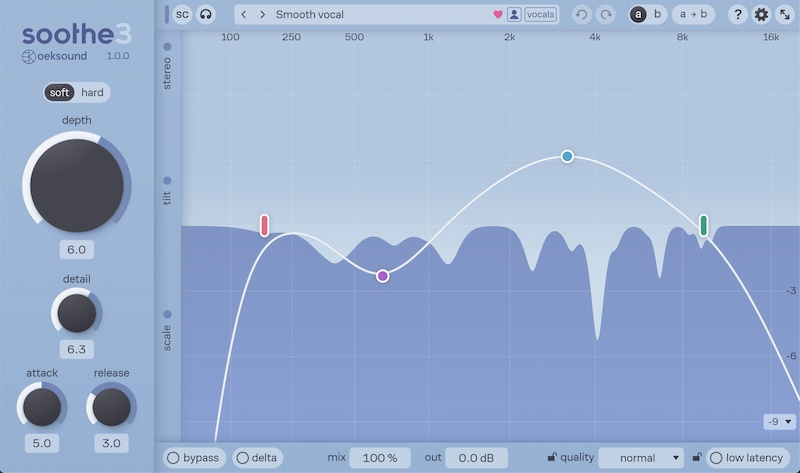
soothe3 is a dynamic resonance suppressor that is visually intuitive and can be operated with the feel of an equalizer.
It inherits the core function of automatically identifying unwanted resonances within an audio signal and applying optimal reduction only where it is needed, while significantly improving the algorithm compared to its predecessor soothe2.
Advanced processing minimizes unnatural artifacts, allowing harsh components to be reliably removed without sacrificing the transparency of the source material.
Key Features of soothe3
- Eliminate harshness from any source
- Automatically targets resonances that change moment by moment
- Cleans up muddiness, boxiness, and proximity effect
- Naturally suppresses sharp piercing sibilance
- Provides pro-quality results with zero latency during tracking
- Built on the latest algorithms cultivated through the development of “bloom” and “spiff”
Improved Algorithm (Soft / Hard Modes)
The two algorithms “Soft” and “Hard” that were already part of soothe2 have been refined, enabling more natural processing with greater clarity.
- Soft Mode: A mode capable of natural, clear sound shaping. It employs an adaptive threshold, allowing natural processing even on instruments with strong dynamics. A reliable starting point that can be applied universally to any source.
- Hard Mode: Inherits the style of soothe2 and uses a fixed threshold. Suited to more aggressive sound shaping, compressor-like behavior, or extreme sidechain effects. Also ideal for creative applications.
New “Detail” Knob
The two parameters of “Sharpness” and “Selectivity”, which were difficult to grasp in soothe2, have been merged into a single control called “Detail”. Suppression intensity can now be adjusted more intuitively, allowing surgical and precise processing on vocals and other sources.
Advanced Control Features
Several new controls have been added to meet the demands of professional production environments.
- Tilt Control: “Detail”, “Attack”, and “Release” parameters can be adjusted independently for the high and low frequency ranges, giving you the suppression you prefer per band.
- Max Cut Parameter: Setting a maximum value for suppression prevents resonances from being over-reduced unintentionally.
- Linear Phase Mode: Adds the ability to process L/R or Mid/Side independently.
New Low-Latency Mode
A newly added low-latency mode enables processing with virtually no delay. This makes soothe3 usable for monitoring during recording sessions and for live performance, and it shines in real-time tracking applications. Letting performers hear something close to the finished sound while recording is a major advantage.
Other New Features
- Multichannel Support: Supports up to 9.1.6 configurations, covering surround and immersive production, with flexible control over channel set linking.
- Flexible Nodes: Nodes can be created and removed more easily, and eight band shapes including band-pass and tilt are available for quick editing.
- Hideable Side Panel: When workflow speed matters, only the main controls can be displayed to free up screen real estate.
3. Other oeksound Plugins
oeksound also develops the following plugins.
bloom
bloom is an adaptive tone-shaping plugin. It analyses the character of the signal and applies corrections to the perceived tonal balance, delivering a more even and polished sound. It can also be used to shape the tone and character of a track — adding warmth, brightness, or clarity. Bloom’s tonal adjustments are dynamic and context-aware. Combined with a carefully designed user interface, it allows quick, intuitive use of the plugin, maintaining a natural sound even when applying dramatic changes.
spiff
spiff is a product dedicated to transient control. Following the success of oeksound’s first plugin soothe, spiff was designed to fill a gap in the sound engineer’s toolkit. It is engineered to cut or boost transients with extreme precision. Like soothe, spiff analyses the input signal and applies processing only to the portions of the signal that contain transient information. This leaves the rest of the signal intact and free of side effects.