

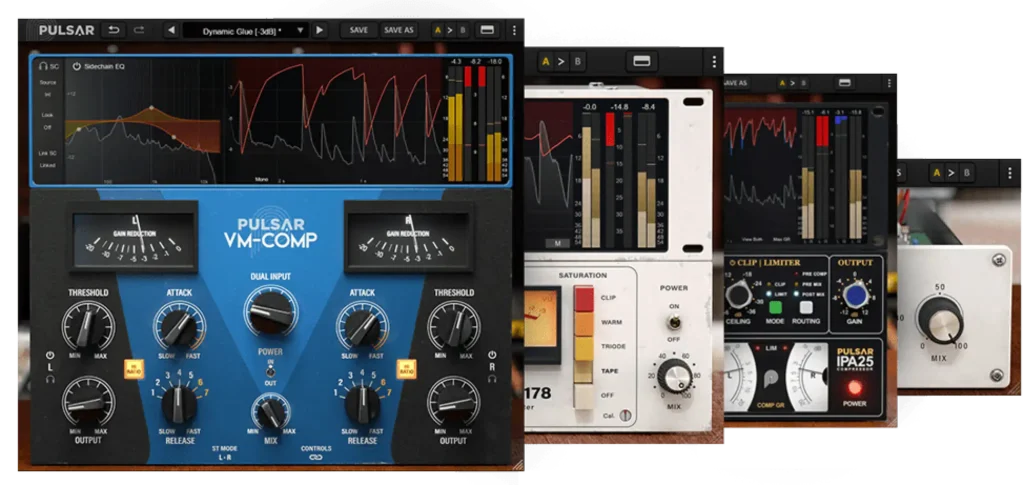


This article introduces the latest sale information for Pulsar Audio, the maker of popular compressor plugins modeled on classic hardware and more.
We also cover an overview of the products and how to activate them after purchase, so please use it as a reference.
This article is updated whenever a new sale starts.
Pulsar Audio Latest Sale Information
Pulsar Audio is currently running the following sale.
Black Friday Sale: Until December 7, 2026
- Pulsar Audio 8200: an EQ that faithfully emulates the legendary GML 8200 with an easy-to-use GUI
- Pulsar Audio Echorec: a magnetic disc delay that recreates the 1960s Binson Echorec
- Pulsar Audio IPA 25: a feature-rich dynamics processor with switchable VCA circuits
- Pulsar Audio MP-EQ (MASSIVE): an EQ emulating the Manley Massive Passive
- Pulsar Audio Poseidon: an inductor EQ that recreates the EQ section of a rare, legendary console
- Pulsar Audio Pulsar 1178: an FET compressor that recreates the 1178 and adds sidechain EQ and saturation
- Pulsar Audio Pulsar Vocal Studio: a vocal multi-effect that puts everything needed to mix vocals on one screen
- Pulsar Audio Vintage Compressors Bundle: a compressor bundle of four plugins: 1178, VM-COMP, IPA 25 and Smasher
- Pulsar Audio VM-COMP (Mu): a hugely popular compressor modeled on a Manley unit
- Pulsar Audio Primavera: a reverb with six spring reverbs, plus saturation and ducking
- Pulsar Audio Primavera & Echorec Bundle: an effects bundle of the Primavera spring reverb and the Echorec delay, which recreates the Binson Echorec
- Pulsar Audio Blue Bundle – MP-EQ & VM-COMP: an effects bundle of the MP-EQ mastering EQ and the VM-COMP variable-bias compressor
- Pulsar Audio Analog EQs Bundle: an analog-modeled EQ bundle of four plugins: Massive, Poseidon, 8200 and W495
- Pulsar Audio Mastering Bundle: a mastering bundle of four plugins: Massive, 8200, Mu and W495
- Pulsar Audio Smasher: a compressor that recreates the 1176 “all buttons in” British mode
- Pulsar Audio W495: a three-band EQ that recreates the Neumann W495 and adds M/S and auto gain
Check the current prices on Plugin Boutique.
Installation and Activation
Activating and authorizing Pulsar Audio products takes the following four steps, but you need an iLok account (a USB dongle is not required).
- Download and install the product
- Launch iLok License Manager and log in
- Enter the activation code from the “…” menu in the upper right
- Activate the product
Pulsar Audio Plugins on Sale and Product Overviews
Here is an overview of Pulsar Audio products, including those on sale.
Product List by Type
| Product | Type |
|---|---|
| VM-COMP | Tube compressor / limiter |
| 1178 | FET compressor |
| Smasher | FET compressor (all-buttons mode) |
| W495 | 3-band EQ |
| Vocal Studio | Vocal channel strip |
| IPA 25 | VCA compressor |
| Primavera | Spring reverb |
| 8200 | Parametric EQ |
| MP-EQ | Passive EQ |
| Echorec | Magnetic disc delay |
| Poseidon | Console EQ |
| DigiTape | Tape saturation (free) |
VM-COMP (Mu)
Effect | Tube Compressor / Limiter
VM-COMP is a compressor that faithfully emulates a modern yet legendary tube compressor/limiter. It is well suited to creating cohesion (glue) in mixing and mastering.
The sound is transparent with a touch of warmth. Unlike FET and VCA compressors, it handles transients softly and musically even at extreme settings, so you can add movement while keeping the natural dynamics of the source.
Key features
- Topology Preservation Technology: recreates the behavior of the real unit, including transformer flux saturation, tube response and even slight calibration errors
- Sidechain EQ: five filter types, band solo and a sidechain listen function
- Mid/side processing: process the center and stereo components with separate settings, and audition each on its own with the Listen button
- Look-ahead / Look-behind: shift the timing of gain reduction before or after the input. Look-ahead gives perfect limiting, and delaying it lets fast transients through and compresses only what follows
- Extended attack and release: faster settings than the original are possible, for more aggressive tones that sit forward in the mids
- External sidechain: ducking, de-essing, and running the sidechain signal through your favorite EQ
- Rich metering: a scrolling waveform and gain reduction meter, a VU-style meter and LED-style input/output meters
- Low CPU load: supports oversampling up to 384 kHz
Pulsar 1178
Effect | FET Compressor
Pulsar 1178 is a compressor that faithfully emulates an analog FET compressor and enhances its features. It is fast, full of character and works for just about any purpose.
It is more transparent than the 1176 and gives you very fast control over transients compared to other compressors. With the all-buttons mode and the saturation added by Pulsar Audio, you can also create strongly colored sounds.
Key features
- Topology Preservation Technology: reproduces diode and transistor saturation, slight internal filtering and calibration errors while keeping CPU load low, because it does not simulate the whole circuit
- Four types of saturation: Tape (magnetic tape), Warm (subtle distortion that suits the highs), Triode (class A tube amp) and Clip (digital clipping)
- Mid/side processing: process the center and stereo components separately, with a Listen button for solo monitoring
- Look-ahead / Look-behind: advance detection by up to 20 ms, or delay it by up to 10 ms to let transients through
- Sidechain EQ: five filter types, band solo and a sidechain listen function
- External sidechain support
- Rich metering: scrolling gain reduction, a VU-style meter and LED-style input/output meters
- Resizable GUI: in many DAWs, inserting it on a mono track opens a simple single-channel view
Smasher
Effect | FET Compressor (All-Buttons Mode)
Smasher is a compressor that recreates the extreme compression of the Urei 1176’s “All buttons in,” or so-called “British,” mode.
The original 1176 let you choose from four ratios, but engineers discovered that pressing all the buttons at once produces a distorted, explosive, heavily compressed sound. Smasher is an original modification of the 1176 circuit that reproduces what happens inside the circuit in all-buttons mode, such as the change in bias voltage. It stays close to the original, making transients more distinct and the tone more aggressive.
It excels at raw, gritty sounds reminiscent of Vulfpeck, The Whitefield Brothers and The Black Keys.
Key features
- Parallel compression with the Mix knob: blend with the original sound so that even when you crush it, you keep the original rhythm and clarity while adding sustain and density
- Linked sidechain: stereo tracks are handled by a single detector, so the stereo image does not collapse even under heavy compression
- Topology Preservation Technology: reproduces inductor flux saturation, transistor response and calibration errors
- Low CPU load: supports oversampling up to 384 kHz
W495
Effect | 3-Band EQ
W495 is an EQ that accurately emulates the Neumann w495 three-band EQ.
The w495 was used to master 90% of the records made from the 1970s to the 1990s, and it is still loved by many mastering engineers. Its wide EQ curves stay musical even when pushed to extremes, and it can be used both for shaping individual tracks and for adding presence and depth to a whole mix.
The real unit is modeled component by component, reproducing the subtle saturation of each band and even the low-end coloration of the output transformer (Haufe RK 756). The high shelf adds clarity without harshness, the low shift adds weight without muddiness, and the mid band gives energy to material that lacks power.
Key features
- On-screen curve editor: linked to the knobs below, it lets you set frequency, gain and Q continuously
- Three bands: low shelf, parametric bell and high shelf. You can also switch to fixed values only, as on the real unit
- Per-band mid/side processing: for example, cut only the side mids to focus on the center, boost only the low mids of the mid channel, or boost only the highs of the side channel
- Auto gain: compensates for volume differences according to the EQ curve (it does not change during playback)
- Spectrum analyzer and meters: real-time display, plus Infinite Spectrum, which shows a long-term average
- Includes presets by top engineers
- Oversampling: up to 384 kHz. You can also use a higher setting only when exporting
Pulsar Vocal Studio
Effect | Vocal Channel Strip
Pulsar Vocal Studio is an all-in-one vocal mixing plugin that puts professional-quality vocal processing tools on one screen. Vocal processing that normally requires multiple plugins and complicated routing can be tried in a few clicks.
Instead of relying on a single compressor or de-esser, it chains multiple dynamics stages in series so that the next stage tames what the previous stage lifted. As a result, with few adjustments you get vocals with stable dynamics and frequency balance, whatever the singer or voice. It is built to hold together on a high-end audio system, small speakers or a phone in mono.
Key features
- Three types of compression: types inspired by legendary analog compressors and modern digital algorithms
- Three types of saturation: Tube (smooth vintage warmth), Germanium (edgy grit) and Solid-State (clear, modern punch)
- Focus EQ: dynamically moving bands add air and presence without harshness
- EQ section: instantly choose tonal characters such as warmth and brightness, and use the on-screen parametric EQ when you want to fine-tune
- De-esser: targets only sibilance and leaves the rest untouched
- Reverb and delay: a convolution reverb and a variety of delays, from vintage tape echoes to modern ones
- 11 special FX: Wide Stereo, HF Whisper, Classic Chorus, Ultra Large, Wide Octave, Phasy Motion, Soft Breath, Thick Octave, Wide Movement, Breathy Octave and Wide Whisper, based on vintage wideners, octave processing and original spectral processing
- Constant Gain Monitoring: automatically matches output level so you are not fooled by the illusion that louder sounds better
- More than 80 presets: includes signature presets by Chris Tabron, Matt Sim, John Nathaniel, Ryan Sanchez, Digital Cut, Wheeliemix and Calvin Bennett
IPA 25
Effect | VCA Compressor
IPA 25 is a multi-VCA dynamics processor that recreates the behavior of a classic VCA compressor and adds modern features such as circuit switching and a clipper/limiter.
After reproducing the original’s RMS detection, ratio-dependent knee and program-dependent release, it adds features the hardware did not have. You can switch character without interrupting your work, from mastering-grade accurate VCA to tube-like warmth and diode grit.
Key features
- Four characters: V-Mu (tube-like, with fuller low mids and softened edges), IPA 25 (the original VCA, punchy and precise), N-Diode (asymmetric clipping for grit and mid push) and Clean VCA (transparent control). The detector and settings stay the same and only the harmonics of the gain reduction stage change, with each mode level-matched
- Sidechain design: the original NORM / MID / LOUD Punch modes, a 4-band visual sidechain EQ, stereo link adjustment and an external sidechain
- Adaptive clipper/limiter: the limiter acts only on the overshoots and lets low-end sustain pass through. The clipper shaves off peaks instantly. You can place it before the compressor, in the parallel path or after the mix
- Timing adjustments: Lookahead, Lookbehind and a feedforward/feedback switch
- Zero latency and oversampling: zero latency when recording, oversampling when mixing and mastering
- CPU efficiency: CPU load does not jump even when you open several in a large session
- Real-time display: adjust while watching compression, the spectrum and the detector
Primavera
Effect | Spring Reverb
Primavera is a reverb that combines six spring reverbs used on countless hit records into one. From lo-fi to hi-fi, each tank accurately emulates the electronic and mechanical behavior of the original unit.
Rather than sampling the real units, it plays them back with real-time physical modeling, so you can control physical parameters such as spring tension and wobble. It is a reverb chain with built-in saturation, filters, presence and ducking.
Key features
- Six spring tanks
- TWANG “CUSTOM”: a strongly colored, lo-fi sound inspired by guitar amps such as Fender
- Great British Spring: a dense, open sound. The cleanest of the six, for material you want to shine on top of the mix such as vocals
- HR12: a lo-fi reverb made in Japan in the late 60s. It has little low end, and the characteristic spring “boing” is clearly audible
- RE201: based on the Roland Echo RE201. A thick, diffuse reverb that is the most versatile and suits lead vocals too
- SR202: based on a legendary consumer hi-fi reverb. A darker, least dense type with prominent reverb “wobble”
- TUBBY “CUSTOM”: an old-school dub color. A round, watery sound for brass, off-beat keys and guitars
- Main functions
- Tension: changes the spring tension. The tighter it is, the faster and higher-pitched the reverb wobble, and the looser, the slower and lower
- Excitation: automatically shakes the spring in response to input transients, emphasizing the characteristic spring “boing”
- Hit the spring: shake the spring with a mouse click. Also supports modulation and automation
- Drive and Tube / Ger switch: saturation with a pentode tube or a germanium transistor preamp. It also affects the dry sound
- Ducking: lowers the reverb in response to the input (or an external sidechain) to clean up the mix
- Presence, Width, Predelay and Decay: adjust the presence, stereo width, onset delay and length of the reverb
- 12 dB/oct high-pass and low-pass filters
- Hundreds of presets: created by Matt Sim, Craig Bauer and others
8200
Effect | Parametric EQ
Pulsar 8200 is an EQ that faithfully emulates the legendary GML 8200, designed by George Massenburg, the inventor of the parametric EQ.
Like the real unit, it features a tight, solid low end, clear highs and controls that let you target frequencies precisely. It recreates the discrete, class A analog circuit that made its name in the 80s. Thanks to its parallel structure and distinctive filter shapes, the curves are smoother and more natural than a typical digital EQ.
Key features
- On-screen curve editor: edit every setting, including filter names, without touching the panel below
- Built-in de-esser: reduce sibilance and high-frequency transients by frequency, amount and filter type (bell / shelf)
- Tilt filter: a 6-pole Tilt filter adjusts the overall tonal balance with a single knob
- Sub & Air bands, high-cut / low-cut: adjust both ends of the spectrum without muddiness or harshness
- Mid/side processing: with a Listen button for solo monitoring
- Auto gain and Gain Scale (adjust the strength of the whole EQ curve at once)
- Spectrum analyzer and meters: also supports the Infinite Spectrum display
MP-EQ (Massive)
Effect | Passive EQ
MP-EQ is an EQ that emulates the legendary analog passive EQ found in nearly every mastering studio in the world. It was previously named “Massive,” and Massive users can update to MP-EQ for free.
The real unit, designed by combining the best passive EQs of the past 70 years, has a fully parallel structure, so it responds with a musicality quite different from a digital EQ with the same settings. In a parallel EQ, the gain of each band does not simply stack up but combines into a natural correction. Hand-wound inductors, tubes and magnetic saturation from transformers give creamy highs, balanced mids and organic warmth.
Key features
- Linear-phase compensation: you can choose to align the phase shift of all frequencies after the EQ, letting you use an analog-style EQ as a true linear-phase EQ. Transients do not smear and low-end muddiness is avoided
- Drive control: the transformer, tube and inductor models produce a subtle low-end compression feel that depends on the material
- Three output transformers: “Original,” as on the real unit; a more colored type with a warmer low end; and no transformer
- On-screen curve editor: edit all filter settings without touching the panel below
- Mid/side processing: with a Listen button for solo monitoring
- Auto gain, spectrum analyzer and meters
- Oversampling: up to 384 kHz. You can also use a higher setting only when exporting
Echorec
Effect | Magnetic Disc Delay
Pulsar Echorec is a magnetic disc delay that recreates the classic echo/delay of the same name made by Binson of Italy in the 1960s, including its tube circuitry.
It has the sound of a magnetic disc system, different from the tape delays that were mainstream at the time, and shaped the sound of many 70s bands such as Pink Floyd, The Shadows and Jimmy Page. The vintage Echorec is known for saturation, self-oscillation and its distinctive smearing of sound, but it is also a fragile machine that is hard to maintain.
With a dense sound somewhere between delay, reverb and saturation, it can also be used for sound design, such as adding depth to samples, changing rhythm and pitch, and making risers and fallers.
Key features
- Three units modeled: three units in different conditions were modeled, covering everything from the cleanest magnetic delay to the roughest sound
- Motor speed change and tempo sync: change the delay time in real time and sync to any tempo, including tap tempo
- Tube input stage: recreates the all-tube input stage, including the pre-emphasis filter
- Magnetic modeling: models magnetic saturation and hysteresis inside the disc
- Stereo Drift: shifts left and right slightly for a wide stereo echo where the position of each repeat is distinct
- Creative modulation: recreates pitch changes like slowing the disc with a finger, as well as wow and flutter
- Off mode: add only the color and grit of the tubes and magnetics, with no delay
Poseidon
Effect | Console EQ
Poseidon is an EQ modeled on the inductor EQ of a rare, legendary console, turned into an easy-to-use modern tool. This console’s EQ shaped the sound of records by Queen, The Beatles, David Bowie, The Rolling Stones and others.
A big reason for its musicality is the unique interaction between the bands: raising the gain of just one band produces a curve that would take three or four bands of a parametric EQ. That makes it a difficult EQ to handle, but Poseidon displays the curve behaving just like the real unit’s quirks, so you can master it quickly.
Key features
- Reproduces interaction between bands: the shape of one filter depends on the other settings, producing asymmetric bells and unique curves. You can see it on screen as you work
- Continuously variable frequencies and extended range: the real unit had only fixed frequencies, but you can set them continuously and the range has been extended
- Two types of saturation: a recreation of the original console circuit, and a more modern, aggressive Pulsar Audio original
- Two output transformers: output transformers that the original console did not have, one inspired by the Marinair of old Neve preamps and an original one that emphasizes low harmonics
- Per-band mid/side processing
- Auto gain, Gain Scale, spectrum analyzer and meters
- Oversampling: up to 384 kHz
DigiTape
Effect | Tape Saturation (Free)
DigiTape is a free tape saturation plugin that combines two early-2000s digital tape algorithms. It comes with a perpetual license.
The early tape plugins of the 2000s had a distinctive character that today’s highly accurate tape models lack, and they shaped the sound of the time. These algorithms were made in an era of limited processing power by engineers who knew tape machines inside out and decided by ear and musical judgment what to keep and what to leave out. DigiTape pays tribute to that effort, packing two algorithms that work well together into a plugin with a light CPU load.
Two modes
- CONTOUR: boosts the highs before saturation so they saturate first, then restores the tonal balance with a later filter. The highs are compressed and transients are rounded
- GRAIN: splits the signal into three bands, saturates the lows and mids and reduces the original highs. Harmonics generated in the lower bands fill in the highs, adding thickness and texture
The five CONTOUR Types
- HALO: the most neutral. Adds CONTOUR color with minimal effect on balance
- GASOLINE: close to HALO, with more weight in the lows and mids
- FLARE: a stronger compression curve with a stronger effect on transients and density
- SHEEN: gentle in small amounts and stronger as you raise Mix. At maximum, it reaches the character of SHADE
- SHADE: even stronger compression than FLARE, with coloration over a wider range of frequencies
Main parameters
- Drive: the amount of saturation, from subtle warmth to gritty distortion
- Brightness: adjusts the color of the highs from Dark to Bright
- Processing (Dry/Wet): the amount of processing. In CONTOUR it also changes how the saturation stage is involved, affecting the color and the shape of transients
- Group: link multiple DigiTapes and choose the parent for automation
That covers the latest sale information for Pulsar Audio.