

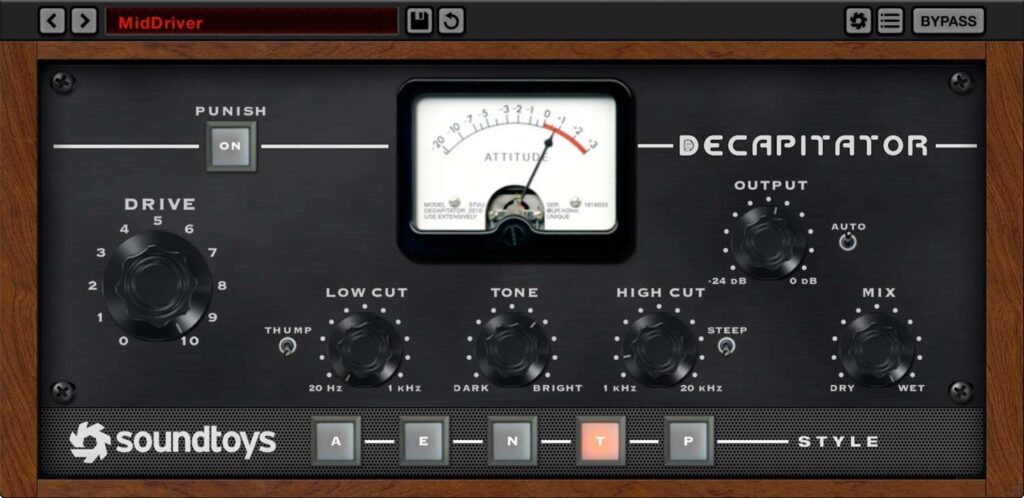
This article covers the latest sale on Soundtoys’ popular analog saturation plugin, Decapitator, along with a quick overview of the plugin and how to activate it after purchase. We will update this page whenever a new sale starts.
Latest Decapitator Sale
The following sale is currently running on Decapitator.
Decapitator Sale: Ends October 20, 2026
Soundtoys Decapitator, the analog saturator with 5 classic hardware-modeled styles, is on sale until October 20. Check current price on Plugin Boutique.
Buyers at Audio Plugin Deals, Plugin Boutique and ADSR Sounds may also receive bonus freebies with their purchase.
What Is Soundtoys Decapitator?
Decapitator is a plugin featuring 5 analog saturation styles modeled on studio hardware. It covers everything from subtle coloration to screaming, aggressive distortion in a single plugin.
What Saturation Can Do
The sound of tubes, transistors and circuits pushed to their limits is a key ingredient of classic recordings from the analog era. Saturation is used to thicken a sound, thin it out, add edge, add warmth, pull a track forward in the mix, or create a distinctive character.
An Analog Model That Reacts, Not a Static Snapshot
During development, vintage and modern consoles, preamps, input channels, EQs, compressors and studio distortion units were collected and analyzed, and the pieces with the strongest character were modeled.
Unlike a fixed convolution snapshot, the model changes in response to the input. It follows the dynamics of the track, so even subtle changes in playing intensity are reproduced.
5 Styles (Saturation Models)
Switch between them with the Style buttons at the bottom of the GUI. Each style matches the harmonic structure, frequency response and dynamic behavior of the original hardware, including when it is driven past its limits.
| Style | Modeled After | Sound Character |
|---|---|---|
| A | Ampex 350 tape recorder preamp | Equipment used on 1950s records from Sun, Stax, Motown, Chess Records and others. Very smooth tube distortion |
| E | Chandler / EMI TG Channel | Based on EMI / Abbey Road consoles. Fat low end and a smooth, airy top end |
| N | Neve 1057 input channel | Early Neve using germanium transistors. Weighty lows and focused mids, especially effective on guitar |
| T | Thermionic Culture Culture Vulture (Triode setting) | Triode distortion rich in even-order harmonics. Warm and punchy, great for drums and percussive instruments |
| P | Thermionic Culture Culture Vulture (Pentode setting) | Pentode distortion centered on odd-order harmonics. A different character from Triode |
Punish Button
Pressing the Punish button between the Drive knob and the Attitude Meter adds another 20 dB of gain. It is not the fizzy distortion of a cheap stompbox but the texture of high-end studio gear pushed into the red zone, and it distorts differently for each style. It is effective for adding excitement to vocals, drums, guitars, synths and other sounds that are too tame.
Parameters
| Parameter | Description |
|---|---|
| Drive | Equivalent to the input level into the analog circuit. The higher it is, the more it distorts, and how it distorts depends on the style. Output level also rises |
| Punish | Adds 20 dB of gain. Output level also rises |
| Attitude Meter | A VU meter showing the input level to Drive (it does not show output). Its design is based on the vintage Simpson VU meter found on the Ampex 35X series |
| Low Cut | Cuts the lows before saturation. Prevents muddiness when distorting low-heavy sounds |
| Tone | A gentle EQ (close to a tilt EQ) that adjusts the overall color from Dark to Bright. It is applied before saturation, so it changes which frequency ranges get distorted |
| Thump | Boosts a few dB around the Low Cut frequency. Similar to the “head bump” of analog tape |
| High Cut | Cuts the highs after saturation. Reduces the fizzy components produced by distortion |
| Steep | Switches the High Cut slope. OFF is 6 dB/oct, ON is 30 dB/oct |
| Output | Output level. Lets you control distortion amount and volume separately |
| Auto | Auto gain. Output is lowered automatically as you raise Drive |
| Mix | Balance between the dry and processed signal. Lets you do parallel processing without routing or submixes |
Where Each Control Sits in the Signal Path
Before saturation: Low Cut / Tone / Thump
After saturation: High Cut
Handy Tips
- Cabinet-style sound: Turn Steep ON and set High Cut around 4 to 5 kHz to get a sound like a guitar amp speaker cabinet (also useful for a direct-recorded guitar vibe)
- Telephone / AM radio sound: Set Low Cut and High Cut to extreme values for a lo-fi telephone or AM radio effect
- Keep the attack: Blend in the dry signal with Mix to recover transients that saturation has shaved off. It works like a parallel compression technique
Key Features
- Adds the natural texture of analog gear to your tracks
- 5 finely modeled studio hardware styles deliver realistic, dynamic saturation
- The Punish button lets you distort even more aggressively
- Analog-modeled tone controls shape the contour of the saturation
- The Mix knob makes parallel processing easy
Installation and Activation
Authorizing and activating Soundtoys products requires authentication with an iLok account (an iLok USB is not required).
- Create an iLok account and download iLok License Manager
- Register and download the product on the Soundtoys site (this is where you register the license number you got from the store)
- Launch iLok License Manager, sign in and activate
Soundtoys Product Pages
Check the full Soundtoys lineup at these stores.